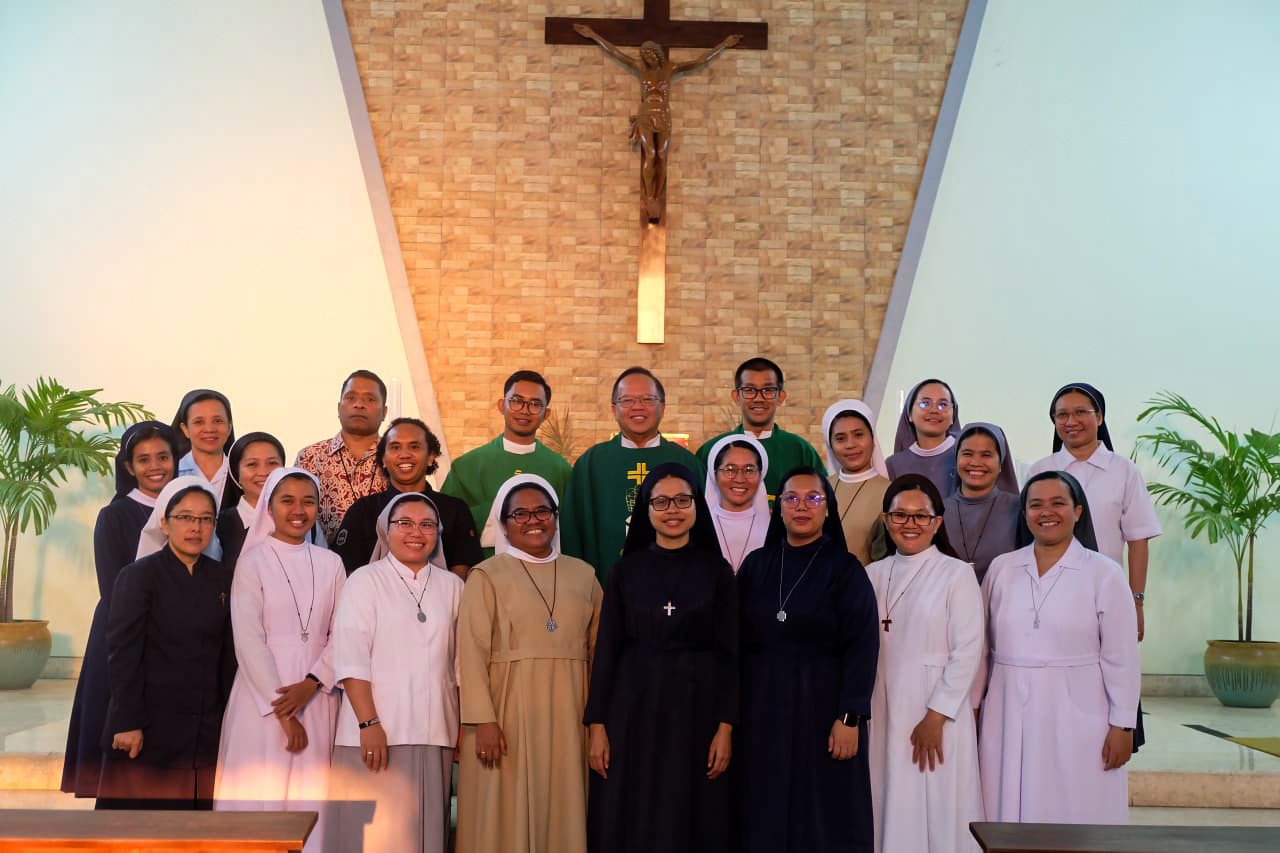
SFIC stands for “ “Sororum Franciscalium Ab Immaculata Conceptione A Beata Matre Dei.” “In Indonesian, SFIC is officially translated as the “Congregation of the Franciscan Sisters of the Immaculate Conception of the Holy Mother of God.”
The SFIC Sisters embody the spirit of service expressed in their motto: “All for the Love of God,” as passed down by the Foundress of the SFIC Congregation, Sr. Teresia van Miert. This motto serves as a foundation in the heart of every SFIC sister, guiding their response to God’s call to consecrated life within the Church. Through dedication to the needs of the times, the sisters carry out various ministries that have been part of the congregation since its founding. The spirit that animates the SFIC Congregation is rooted in four core values: simplicity, obedience, love, and self-mortification.
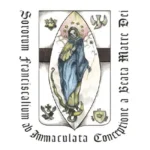
The Meaning of the SFIC Logo

- The logo/medal features an image of "Our Lady of the Immaculate Conception", who is also the patroness of the SFIC Congregation.
- At the four corners, the following symbols are placed:
- The Holy Spirit in the upper right corner.
- The Trinity in the upper left corner, with the word Yahweh written in Hebrew.
- The Shield of Archangel Michael in the lower right corner, inscribed with Latin text. Quis ut Deus – Siapa seperti Allah;
- The Franciscan Order emblem in the lower left corner, featuring two crossed hands—one representing Christ and the other representing St. Francis—with the San Damiano Cross in the center.
FIC Vision and Mission
- Vision: The wholeness of all created beings in justice, love, and peace.
- Mission: To find ways to alleviate the suffering of those around them (SFIC Constitution, Spiritual Foundation, Chapter I, lines 4-6) by healing the wounded, uniting the broken, and calling back the lost (SFIC Constitution, Spiritual Foundation, Chapter I, lines 25-28).
History of the Founding of SFIC
In the mid-19th century, Veghel, a small village in the Netherlands, was known for its large population of poor residents. Life there was filled with challenges, including high unemployment, homelessness, and limited access to education for Catholic children. This situation became a major concern when Father Bernardinus Joannes van Miert was appointed as the parish priest of Veghel in 1840.

One of the initial steps taken by Father Van Miert was to focus on the education of young girls. To achieve this, he entrusted the task to the Sisters of Charity from Den Bosch. However, he soon realized that the issues in Veghel extended beyond education. He identified unemployment as the root cause of various crimes that were troubling the community.
With a clear vision, Father Van Miert was determined to expand charitable works in his parish. He sought to transform the lives of the homeless and beggars in Veghel. In his view, the homeless needed guidance to find proper shelter, while beggars should be taught skills that would enable them to be productive. His ideas gained support from financially capable parish members. In 1842, the necessary building for this mission was finally constructed.
Father Bernardinus Joannes van Miert still faced various challenges, as most of the sisters in his parish were already engaged in education. Additionally, they were assigned by the motherhouse to care for ten foster children. These sisters lived in a branch house that was entirely dependent on the motherhouse, with an unstable number of personnel.
Father Van Miert requested permission for the Sisters of Charity from Den Bosch to settle in Veghel and be under his administration as the parish priest. However, his request was denied by the motherhouse in Den Bosch. As a result, the sisters were recalled to Den Bosch, leading to the closure of the branch convent in Veghel.
To continue the work that had already begun, Father Van Miert selected seven women to carry on the mission. He then appointed his own niece, Yacoba Petronella Anna van Miert, to lead the initiative.
At the Veghel rectory, the call to religious life began to take root in the heart of 21-year-old Jacoba Petronella Anna van Miert. Father Bernardinus van Miert remained steadfast in his desire to establish a community of sisters in the Veghel parish. This hope started to materialize through his niece, Jacoba, along with two other young women who also aspired to become sisters: Maria van Hoof and Maria de Roy.
On June 8, 1843, Father Bernardinus personally accompanied the three candidates to the convent in Rozendaal to begin their novitiate under the guidance of Sister Mere Joseph. Throughout their journey to Rozendaal, they continuously prayed, seeking strength from God with the words, "Confirm, O Lord, what You have begun in us." (The convent in Rozendaal was home to the Sisters of the Penitents-Recollectines, a congregation of the Third Order Regular of St. Francis of Assisi).
On June 23, 1843, they received their religious habits from the hands of Monsignor Hooydonk, following the Third Order’s religious ceremony. The three women were given their religious names as follows:
- Jacoba Petronella Anna van Miert received the religious name Sister Maria Theresia of St. Joseph
- Maria van Hoof received the religious name Sister Maria Bernardina of the Holy Name of Jesus.
- Maria de Roy received the religious name Sister Maria Francisca of the Holy Family.
On June 23, 1844, they returned from Rozendaal and arrived at the Veghel Parish the following day, June 24, 1844. This date was later commemorated annually within the congregation with a special celebration as the founding day of the SFIC (Sisters of Franciscan of the Immaculate Conception). Father Bernardinus van Miert welcomed them with great joy, hoping that these young sisters would assist him in realizing his vision of service in the parish.
On June 25, 1844, Sister Mere Joseph officially appointed Sister Theresia van Miert as the superior general. Although the convent in Veghel was still a branch of Rozendaal at that time, **on June 26, 1844, Sister Mere Joseph returned to Rozendaal. Shortly after her departure, the Veghel convent separated from the motherhouse and became an independent convent under the leadership of Sister Theresia van Miert.

The SFIC Congregation was canonically established on September 19, 1844, by His Excellency Monsignor Zwijsen. Later, on April 24, 1870, the Congregation was officially recognized as a religious institute in Rome under the name “Sororum Franciscalium ab Immaculata Conceptione a Beata Matre Dei”. The Congregation’s Statutes and Constitutions were approved by Pope Pius IX. On December 8, 1929, the SFIC Constitution was reviewed and subsequently reapproved by Pope Pius XI.
SFIC Missionary Work
After its establishment, the SFIC Congregation grew rapidly and steadily. The number of members continued to increase, along with the expansion of its ministries and branch houses in various locations. This development was not limited to several dioceses in the Netherlands but also extended to different countries worldwide. Below is a brief overview of the journey and presence of the SFIC Congregation in various countries, including Indonesia
- 1906: The First SFIC Missionary Sisters in Borneo, the first generation of SFIC missionary sisters successfully set foot on the land of Borneo, specifically in Singkawang.
- 1929: The first generation of SFIC sisters successfully landed in the Philippines.
- 1962: They pioneered mission work in Tanzania, East Africa. However, SFIC's work in Tanzania only lasted until 1975. Now this mission work has been closed.
- 1985: Pioneered mission work in Bangkok, Thailand.
- 1989: Started mission work in Tokyo, Japan.
- 1994: Pioneered a joint mission in Kenya, Africa by opening an international community unit.
- 2008-2020: Pioneering work in Canada. However, this mission work was closed in 2020.
- 2010: Started work in the Southern Philippines region.
SFIC in Indonesia
The beginning of the SFIC Congregation's mission journey in Bumi Borneo, precisely in Singkawang, West Kalimantan, began at the invitation of Father Prefect, Mgr. Pacificus Bos OFMCap, representing the Capuchin Friars and young Catholics in the area. Responding to the invitation, on November 28, 1906, five SFIC sisters arrived in Singkawang as pioneers of mission work in West Kalimantan. The five pioneer sisters of the first generation of SFIC in Borneo were:
- Sr. Rogeria Vissers SFIC.
- Sr. Silvestra van Grinsven SFIC.
- Sr. Alexia Helings SFIC.
- Sr. Emerentiana van Tiel SFIC.
- Sr. Fidelia Grassens SFIC.

The pioneering SFIC sisters in Borneo were faced with a completely foreign field of service. They had to struggle in an undeveloped environment, with minimal social facilities, and with various real challenges in daily life. Extreme climate differences, limited understanding of the local language, and the threat of deadly diseases such as cholera and malaria were tough tests for them. In addition to external challenges, they also faced personal crises, such as feelings of alienation in a foreign country, loneliness, and difficulty communicating with the local people.
However, the strong urge to start a work of love for the growth of the Kingdom of God gave them strength and determination. With an undaunted spirit, these five SFIC sisters became the first generation of missionaries who paved the way for mission work in Borneo.
SFIC in Four Dioceses in Indonesia
The early work of the first generation of SFIC missionary sisters in Singkawang, West Kalimantan, focused on serving the community. They supported the Capuchin missionary priests in spreading the Good News through education and health services. This concrete effort was realized by teaching local children, caring for the sick and lepers, and providing shelter for orphans and the abandoned.
Along with the development of the times in Indonesia, the ministry of the SFIC Congregation continues to expand. Until now, their work traces are present in four diocesan areas.
- 10 SFIC Sisters communities in the Archdiocese of Pontianak.
- 4 SFIC sister communities in the Diocese of Sanggau.
- 1 SFIC Sisters community in the Archdiocese of Jakarta.
- 3 SFIC Sisters communities in the Archdiocese of Makassar.
Here are some important addresses of the SFIC Congregation:
- Generalat SFIC: # 80 Champaca Street, Marikina Heights Marikina City, Philippines
- Provinsialat SFIC: Jl. Tamar no.8 Pontianak-Kalimantan Barat, Indonesia.
Media Sosial